You’ve decided your business needs a new app. Maybe it’s for tracking inventory, managing clients, or automating a task your team still does by hand. Now comes the harder question: do you build it with a low-code platform, or go the traditional custom-development route?
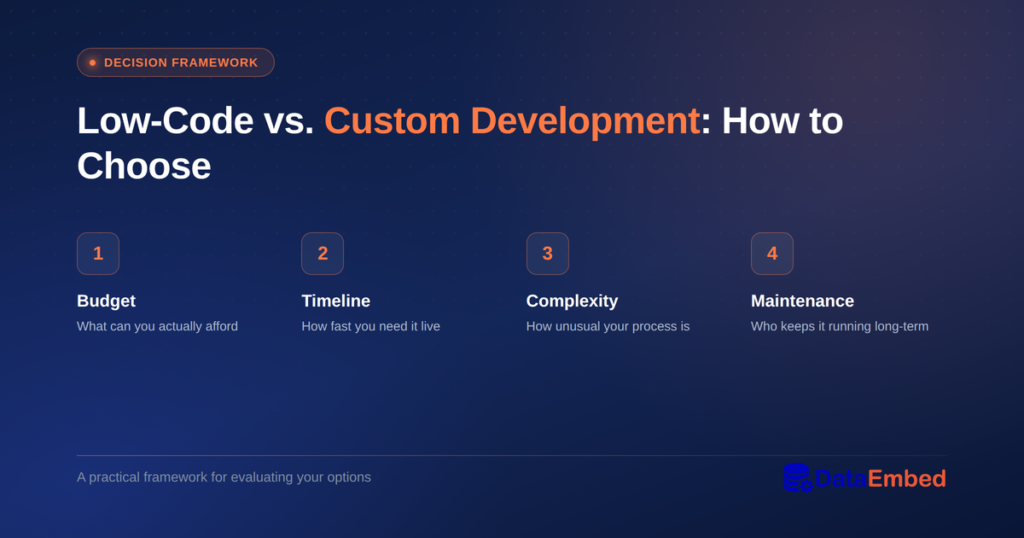
Both paths can get you a working app. However, they differ a lot in cost, speed, and how well the result fits your business long term. Here’s a simple framework to help you decide, built around four factors: budget, timeline, complexity, and maintenance.
Budget: What Can You Actually Afford?
Traditional custom development usually costs more. A developer builds everything from scratch, including the underlying database, security, and infrastructure. As a result, project costs can run into tens of thousands of dollars before you see a working product.
Low-code platforms flip that equation. Because a lot of the infrastructure already exists, a small team can build your app faster and for less. For example, a low-code build might cost a fraction of a custom one, while still delivering the core features you need.
That said, cheaper isn’t always better. If your app needs to do something highly specialized, a low-code platform might struggle. So the real question isn’t just “what’s cheaper,” but “what’s cheaper for what I actually need.”
Timeline: How Fast Do You Need It?
Custom development takes time. Planning, building, and testing an app from scratch often takes months, sometimes longer for complex projects. If you’re not in a rush, that timeline might be fine.
Low-code development moves faster. Because the platform handles a lot of the groundwork, a team can often deliver a working app in weeks instead of months. If your business needs a solution now, not next quarter, this speed matters a lot.
Complexity: How Unusual Is Your Process?
This is where the decision gets more nuanced. Low-code platforms handle common business needs well: tracking records, managing workflows, generating reports. Most day-to-day business apps fall into this category.
However, if your process is genuinely unusual, with complex logic that doesn’t map to standard patterns, custom development gives you more room to build exactly what you need. Before choosing, ask yourself honestly: is my process actually unique, or does it just feel that way because it’s mine?
Maintenance: Who Keeps It Running?
This factor gets overlooked constantly, yet it matters as much as the build itself. Custom-built software needs a developer, or a development team, to maintain it. If that person leaves, you may struggle to find someone who understands the code.
Low-code platforms tend to be easier to maintain. Changes can happen faster, and the platform itself handles a lot of the underlying upkeep. Over time, that difference in maintenance effort adds up to real savings.
Bringing It All Together
Here’s a simple way to think about it. If your budget is tight, your timeline is short, and your process fits common patterns, low-code is usually the better fit. If your budget allows for a bigger investment, your timeline has room to breathe, and your process is genuinely unique, custom development may be worth it.
We’ve built PalletCore, our own warehouse pallet management system, on a low-code platform. That choice let us move fast without sacrificing the features that matter to warehouse teams. It’s a useful reminder that low-code isn’t a compromise; for the right project, it’s simply the smarter build.
Whichever path fits your business, the goal stays the same: software that solves your actual problem, without costing more time or money than it needs to.
#PalletCore #DataEmbed #SoftwareDevelopment