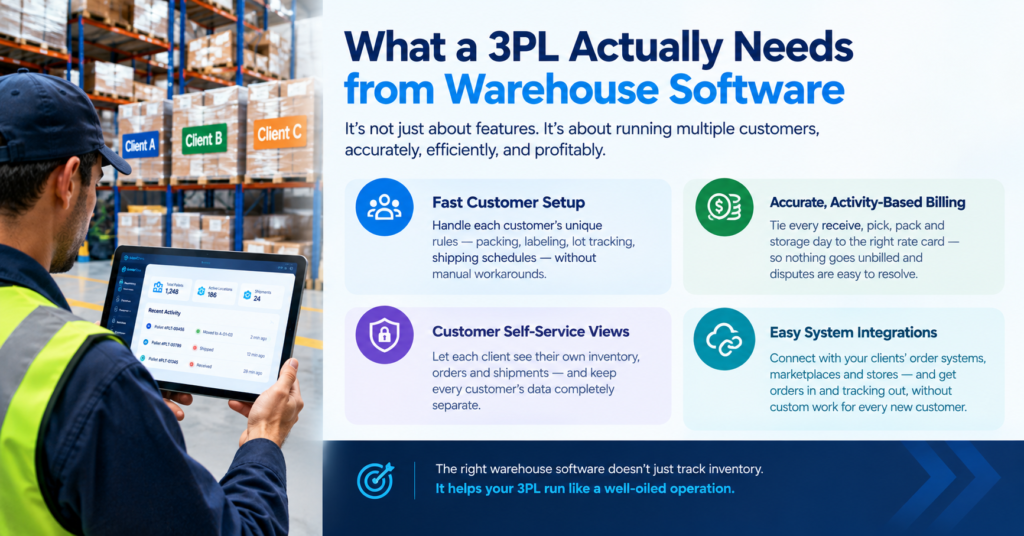
A 3PL needs software that can handle customer-specific rules, connect warehouse activity to billing, give clients secure access to their own inventory, and integrate with the systems they already use.
The 3PLs that get the most out of their software share one trait: they stopped asking “does it have the feature?” and started asking “does it let us run ten customers like they’re one operation?” In projects like PalletCore with multi-customer warehouses, the results came from a handful of priorities that rarely appear on a vendor’s feature checklist.
If you run a third-party logistics business and you’re comparing options, this is what to look for.
Every customer is a different business, and the software has to keep up
A company that runs one warehouse for itself has one set of rules. A 3PL has as many sets of rules as it has customers. One client wants cartons labeled a certain way. Another needs lot tracking for expiry dates. A third ships only on Tuesdays and Thursdays and charges you a penalty for mistakes.
In the operations we’ve seen work well, the software handled these differences through settings, not workarounds. A new customer was set up in days, because their rules were entered into the system rather than taped to a pillar on the warehouse floor or carried in someone’s head.
What to ask in a demo: “Show me how you’d add a customer with unusual packing and labeling requirements. How long does that take, and who has to do it?” If the answer involves a developer or a change request, expect delays every time you sign a new client.
Billing is where margins are won or lost
Many 3PLs lose money quietly, not on storage or labor, but on charges they never billed. A pallet stored a week longer than agreed. A rush pick. A returns inspection. If the system doesn’t capture these activities automatically, someone has to reconstruct them at month-end, and some always slip through.
The operations that saw the clearest improvement were the ones where billing was driven directly by warehouse activity. Every receive, pick, pack, and storage day was tied to a customer’s rate card as it happened. Invoices became a report rather than a project. Disputes dropped, too, because you could show the customer exactly what happened and when.
What to ask: “Can I see an invoice and trace each line back to the warehouse activity behind it?” If you can’t, you’ll be defending your charges with spreadsheets.
Your customers want to see their own inventory, and only theirs
Clients increasingly expect to check stock levels, order status, and shipments without emailing your team. Every one of those emails is staff time you don’t bill for.
A good system gives each customer their own view of their own data, and nothing else. This matters for two reasons. First, it cuts the “where’s my order?” traffic that eats your customer-service hours. Second, it protects you: if one client could ever glimpse another’s inventory, you’d lose trust, and potentially the account.
Look for customer access that’s simple enough for a client’s staff to use without training, with clear separation between accounts built in from the start, not added later.
Connections to the systems your customers already use
Your customers sell through online stores, marketplaces, and their own order systems. Orders need to flow into your warehouse automatically, and tracking numbers need to flow back out. When that doesn’t happen, someone retypes orders, and retyping is where errors come from.
The practical test is not whether the software “integrates” in theory, but how much effort it takes to connect a new customer’s setup. Operations that onboarded clients quickly had software that could receive orders in a few common formats and send updates back without custom work for each client. Those that didn’t ended up with a pile of one-off connections that broke whenever a customer changed something on their end.
What to ask: “How were the last three customers connected for another operation like mine, and how long did each take?”
Putting it together
When you evaluate warehouse software as a 3PL, weigh these four things above the rest:
- Fast customer setup with rules held in the system
- Billing tied to real activity, so nothing goes unbilled
- Customer self-service views that keep each client’s data separate
- Easy connections to the order systems your clients already use
A long feature list is easy to build. What separates a good fit is whether the software lets you add customers, bill accurately, and keep clients informed without adding headcount each time you grow. Bring these questions to your next demo, and ask for answers you can see on screen, not promises on a slide.
#PalletCore #DataEmbed #CaseStudy